While reading the well-loved Isaiah 40, I found myself wondering—what came before this soaring message of comfort? Isaiah 39 surprised me. It’s a chapter of prophetic warning, stark and sobering. The contrast couldn’t be sharper.
A Visit, A Boast, A Missed Opportunity
Isaiah 39 recounts the visit of Babylonian envoys to King Hezekiah, shortly after God miraculously healed him from a terminal illness. But instead of glorifying God, Hezekiah proudly displayed his wealth and armaments—boasting of temporal treasures rather than divine mercy.
I found that foolish and ungrateful. What could be more worthy of praise than miraculous healing? Yet Hezekiah chose to exalt his possessions over God’s power.
Yet maybe I would have responded in the same way. Pride is also a problem for me.
A Strange Response to Doom
Even more puzzling was Hezekiah’s reaction to Isaiah’s prophecy of destruction:
Then Hezekiah said to Isaiah, “Yahweh’s word which you have spoken is good.” He said moreover, “For there will be peace and truth in my days.”
Isaiah 39:8 WEB
I expected anguish. Pleading. Repentance. After all, he had begged for healing earlier—why not now?
Was it because the prophecy didn’t feel personal or immediate? Did pride hold him back from asking for mercy again? Or did he assume God wouldn’t intervene twice?
Whatever the reason, Hezekiah accepted the judgment and found comfort in the fact that he wouldn’t live to see the fallout.
Would I have also done the same? I find that I hold myself back, being conscious of not coming across as greedy. But shouldn’t I be greedy for God’s blessings?
Personal Failure in a National Story
The Babylonian Exile wasn’t triggered by one man’s failure. It was the result of generations of covenant-breaking—persistent unfaithfulness by Judah’s kings and people.
Isaiah 39 zeroes in on Hezekiah—not Judah as a whole. His prideful display becomes the catalyst for a specific judgment: his treasures will be looted, and his descendants taken as eunuchs to Babylon. This isn’t just a national crisis—it’s a deeply personal consequence.
This reminds me that even in the sweep of history, God sees the individual. He is infinitely interested in personal encounters and experiences.
Finding Jesus in Isaiah 39
So how do we see Jesus in a chapter filled with pride, failure, and impending doom?
The Humble King
Jesus can be seen as the anti-type to Hezekiah.
Hezekiah flaunted his riches. Jesus, by contrast, emptied himself (Philippians 2:6-8). Jesus didn’t come with military might or earthly wealth. His treasure is the gospel of grace, freely offered to all nations.
Jesus’ Deliverance
Where Hezekiah’s pride led to loss, Jesus’ humility brings salvation. He is our deliverance from destruction.
The Perfect King
Hezekiah was one of Judah’s best kings—yet still flawed. His story reminds us that no human leader can perfectly shepherd God’s people.
Only Jesus, the true King from David’s line, leads without failure. His obedience secures eternal peace.
I look at the world today and remind myself that no political leaders are perfect. I wait for the day when Jesus will reign.
In summary, Isaiah 39 stands as a cautionary tale—a mirror reflecting our need for a Messiah. In Hezekiah’s shortcomings, we see the brilliance of Christ’s perfection.
Closing Prayer
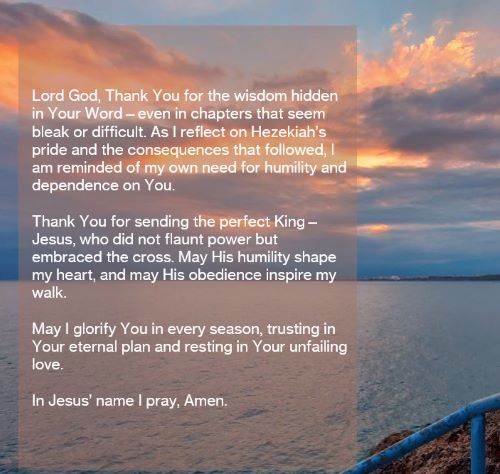
Lord God, Thank You for the wisdom hidden in Your Word—even in chapters that seem bleak or difficult. As I reflect on Hezekiah’s pride and the consequences that followed, I am reminded of my own need for humility and dependence on You.
Forgive me when I boast in my strength, my wealth, or my accomplishments. Teach me to boast only in Your grace, Your mercy, and the miraculous healing You offer through Jesus.
Thank You for sending the perfect King—Jesus, who did not flaunt power but embraced the cross. May His humility shape my heart, and may His obedience inspire my walk.
May I glorify You in every season, trusting in Your eternal plan and resting in Your unfailing love.
In Jesus’ name I pray, Amen.


Leave a comment