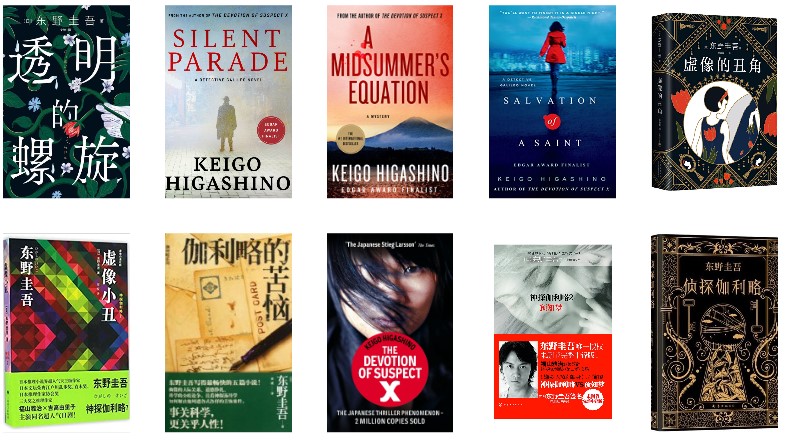
How many books are there in the Detective Galileo series? I can only find 4 in English. But there are actually 10 in Japanese and Chinese.
This book compilation consists of all 10 titles and their short synopses. The first 3 titles are crucial to the series’ success.
Quick Links
Book 1 – Detective Galileo [探偵ガリレオ Tantei Garireo] 侦探伽利略
This is the first book featuring Professor Manabu Yukawa 汤川学, also known as Detective Galileo. He is not actually a police detective. He is a professor of Physics at the university.
He is a college friend of Detective Shumpei Kusanagi. Kusanagi often asked for his help when his cases present puzzling circumstances. Yukawa is often able to uncover the scientific phenomenon behind the mystery through his keen observation, inquisitive mind, cool logic, and scientific knowledge.

There are 5 cases in this collection:
- Burn 燃烧 – A young man suddenly burst into flames. Is this proof of spontaneous human combustion?
- Copy 复制 – An aluminum death mask found by a high school student led to the discovery of a murder victim in a lake. How and when the mask was created became the linchpin to solving the murder.
- Necrosis 坏死 – A man was found dead in his bathtub. Cause of death was undetermined. A bit of necrotic flesh on his chest points to the truth.
- Explosion 爆炸 – How can an explosion leaves no trace? What does the death of a man in an apartment have to do with the explosion.
- Out-of-body 出窍 – Yukawa uncovers the mystery of a witness with an out-of-body experience.
Higashino cleverly weaved in scientific phenomenon and applications into his short mysteries, giving his readers a glimpse into a world that most laypeople find difficult to comprehend.
I know this book is available in Japanese and Mandarin. I don’t think it has been translated into English. If I am wrong, please let me know.
Book 2 – Foresight Dream [予知夢 Yochimu] 预知梦
This book reunites Professor Manabu Yukawa and Detective Shumpei Kusanagi and together, they solve cases that are seemingly paranormal events.
Yukawa connected the dots amongst seemingly unrelated clues to arrive at the scientific explanations behind these paranormal events.
The 5 cases are:

- 梦想 Dream – A stalker claimed that the girl he was harassing is his dream lover. He dreamt about her since he was 10 years old, and he has proof.
- 灵现 Apparition – How did a murder victim appear miles away from the place she was murdered?
- 搔灵 Poltergeist – What is the connection between a missing husband and a house with a poltergeist?
- 绞杀 Strangulation – A man was found dead in a hotel room with strangulation marks. Was he murdered?
- 预知 Foreknowledge – Professor Yukawa uncovers how electro rheological (ER) fluid was used to turn a prank into murder.
Yukawa does not deny the existence of the paranormal, he merely said that he hadn’t encountered sufficient proof of their existence. Although he keeps an open mind, his keen observation skills and inquisitive nature helped him to uncover the truth.
This book is available in Japanese and Mandarin. I don’t think it has been translated into English. If I am wrong, please let me know.
Book 3 – The Devotion of Suspect X [容疑者Xの献身, Yōgisha Ekkusu no Kenshin] 嫌疑人x的献身
A body of a man was found floating in the canal. He was identified as the ex-husband of a woman with a teenage daughter. He was abusive so the woman became the prime suspect. But she and her daughter had rock solid alibi.
This novel catapulted Higashino to worldwide fame. He has a way of misdirecting his readers, making the twist at the end totally unexpected. Nothing is what it seems.

Higashino introduced a new character, Detective Kaoru Utsumi in the first long-form novel of this series. She is a young female detective with keen observations too. She joins Shumpei Kusanagi in his investigations.
Fans who have watched the Japanese TV drama series adapted from the first 3 short story collection would have noticed that she was Professor Yukawa’s partner rather than Detective Kusanagi.
Book 4 – Galileo’s distress [ガリレオの苦恼 Garireo No Kuno] 伽利略的苦恼
This book is Higashino’s third collection of 5 short cases in the Detective Galileo series. It involves Professor Manabu Yukawa, Detective Shumpei Kusanagi, and Detective Kaoru Utsumi.
According to Higashino, these 5 stories caused some form of distress for Professor Yukawa.

- 坠落 Falling – A girl fell to her death from her apartment. A cooking pot with her blood was found in her apartment. Was this suicide or murder? In this story, we began to see a different side of Yukawa, the gentler side.
- 操纵 Manipulation – The son of a retired professor (Yukawa’s teacher) was found murdered in the granny flat on his property. Who killed him? What was the murder weapon?
- 密室 Locked room – Professor Yukawa’s old university friend sought his help to unravel the mystery of a locked room in his inn in the countryside. What really happened to the occupant of the room?
- 指示 Instructions – An old lady with 12 old bars hidden in her home was found strangled to death. Her gold and her dog are missing. The daughter of the prime suspect found the dead dog seemingly through the instructions of a crystal pendant passed down to her by her grandmother. Did she participate in the murder?
- 扰乱 Disruption – The police and Professor Yukawa received letters from a person who revealed that he caused 2 fatal accidents with the Hand of the Devil. It was a race against time to find out what the Hand of the Devil is and who the murderer is.
Higashino is starting to fill in details of Yukawa’s life. His soft spot for determination and persistence. His friends becoming involved in crimes. The story of disruption showcased Higashino’s grasp of criminal psychology.
This book is available in Japanese and Mandarin. I don’t think it has been translated into English. If I am wrong, please let me know.
Book 5 – Salvation of a Saint [聖女の救済, Seijo no Kyūsai] 圣女的救赎
A wealthy business man was found dead in his own home. His wife was miles away visiting her family.
Right from the start, we were told that the wife killed her husband. We know how and why he was murdered. Poison in his coffee. He wanted a divorce.
What we couldn’t figure out was how the poison was introduced.
This novel is more about human psychology than ingenious murder methods.

Detective Kusanagi was Higashino’s main focus in this novel. I sympathized with him as I followed him through the novel eliminating suspects and following up leads that went nowhere.
Book 6 – A Midsummer’s Equation [真夏の方程式 Manatsu No Hōteishiki] 盛夏方程式
Professor Yukawa visits Hariguara as part of a scientific team on underwater mining exploration. Hariguara is a once-popular summer resort town badly in need of development.
A male guest called Tsukahara at the old inn that Yukawa was staying in was found dead at the base of the local cliffs. It looked like an accident except the dead man was a retired policeman and the cause of death was carbon monoxide poisoning.
What was he doing there and what got him killed? The truth is bittersweet.

Up until this novel, Higashino’s treatment of Yukawa is like a mystery-solving tool. His appearance in most of the previous works were brief and passive. In A Midsummer’s Equation, we see a significant departure from that. He was the main investigator although he wasn’t even asked.
Book 7 – The Virtual Clown [虚像の道化師 Kyozo No Dokeshi] 虚像小丑
This is the fourth collection of short stories in the Detective Galileo series. There are actually 2 different editions.
In the first edition of The Virtual Clown, there were only 4 stories (the first 4 in the list below). Another 4 stories were published in a fifth collection titled Galileo: Forbidden Magic 禁断的魔术.

- *幻惑 Illusion – a member of a religious cult jumped to his death during a cleansing ritual. Was it a suicide? It was a simple trick that Yukawa detected after listening to the witnesses.
- *心听 Phantom voices – A man fell to death from his apartment. His colleague stabbed Detective Kusanagi at the hospital. How are these 2 crimes related? Read how Yukawa and Kusanagi uses a third employee to catch the culprit.
- *伪装 Disguise – A beautiful woman discovered her parents dead in their vacation home. It looked like murder but a photo of the dead man in the rocking chair gave the plot away.
- *演技 Acting – A member of a theatre group was murdered in his own home with a knife in his chest. In the beginning of the story, we were told that the ex-girlfriend the one who stabbed the dead man with the knife. Did she turn acting into reality?
- 透视 X-ray vision – a hostess in a high-class bar was murdered because she possesses x-ray vision. A black blurry photo and a school hobby led Yukawa to the trick.
- 曲球 Curved ball – The wife of a baseball player was murdered. It was a case of robbery. Yukawa helped the grieving husband with his throws using scientific methods. What does a rusting car have to do with it all?
- 念波 Telepathy – A twin sister was seemingly able to predict a vicious attack on her older sister. Was it really telepathy? Otherwise, how did she know about the attack?
- 猛射 Blast off – Blast off and Galileo: Forbidden Magic (Book 8) is basically the same story. They share the same characters, premise and ending. In an article, Higashino said that he had more to say about the theme in Blast off than allowed in a short story. That’s why he felt he needed to expand it. I had the same feeling when I was reading Blast off. I wished more was said about the relationship between the politician and his mistress.
After Forbidden Magic was published, Higashino felt the need to rewrite and expand the story of Blast Off into a long-form novel. So, changes were made to publish a second edition of both The Virtual Clown and Forbidden Magic. The first 7 stories were published together under The Virtual Clown, while the final story was expanded and renamed Forbidden Magic 禁断的魔术.
Yukawa’s appearances in all 8 stories are quite substantial, a continuation from A Midsummer’s Equation. The 4 titles with an Asterix are in the original The Virtual Clown.
Book 8 – Galileo: Forbidden Magic [ガリレオ 禁断の魔術 Garireo Kindan no Majutsu] 禁断的魔术
As mentioned, Forbidden Magic (https://amzn.to/3kKw26x) (ISBN: 978-7544294140) was an expansion of 猛射 Blast off.
I remember Agatha Christie did the same with The Plymouth Express and Mystery of the Blue Train.
The crime and motivation were the same but there are much more stuff going on in The Mystery of the Blue Train.

I read both versions. Blast off first and then Forbidden Magic. A reviewer who did the same felt that Forbidden Magic was not better than Blast off. I thought that Higashino succeeded in making the story more compelling by explaining the thread that pulled the young female journalist and the politician together: the power of Science for good.
I would have enjoyed Forbidden Magic more if I hadn’t read Blast Off. I felt that certain scenes were lengthened unnecessarily. There is a hint of padding to make up the word count of a full-length novel.
I wonder if this story will be translated into English. I am quite sure if it is, only the full length version will be available.
Book 9 – Silent Parade [沈黙のパレード Chinmoku no Parēdo] 沉默的巡游
The 9th book in the Detective Galileo series happened 4 years after Forbidden Magic.
Professor Yukawa had left Japan for a research position in the US. He returned to a town whirling over the discovery of the remains of a young girl who went missing 3 years ago.
The police investigations stalled because the prime suspect maintained his silence. However, he was found dead in a locked room after an annual street festival and parade. Many in the town have reasons to kill him but all of them have solid alibis. Will the truth ever be known now?

This novel is both a whodunit and a howdunit. I felt Higashino successfully misled me again.
Book 10 – The Transparent Spiral [透明な螺旋 Tōmei na Rasen] 透明的螺旋
A man was murdered. His fiancé, whom he had physically abused, has a rock-solid alibi. Yet, she went on the run afterwards. What or who is she running from?
Who is her companion? Who is the other woman looking for her?
This murder does not require any scientific explanations. It is designed to bring up Professor Yukawa’s past.
I’m not convinced of the reasons behind Professor Yukawa’s actions in the resolution of this crime. Is Higashino starting to blur the line between the Detective Galileo series and the Detective Kaga series?

Higashino is a prolific writer with a large corpus. Like Agatha Christie with Poirot and Marple, he had also created 2 enduring characters: Yukawa and Kaga. Some critics have criticized Higashino for inconsistent quality.
I think he is a hardworking writer with a lot of ideas. I think it is better to publish and let the readers decide rather than try to write a magnus opus and be a one-hit wonder. What do you think?


Leave a comment