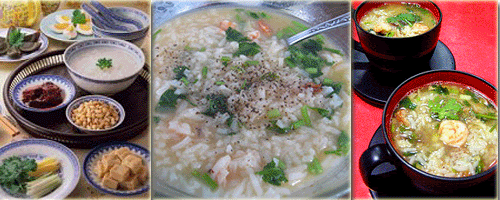
Someone once asked me how to make rice porridge. Just boil rice with water was my lightning-fast response. I apologized. There is more to it than that.
Making rice porridge comes easily to me because I grew up with it as a staple in my diet. It therefore came as a surprise when people ask me how to make it. When I sat down to write about it, I realize it is more than cooking rice with water. So, let me take a step back and deconstruct the process.
3 Basic Rules
Before we dash off, let’s look at a few basic rules. These apply whether you are making Cantonese congee, Hokkien sweet potato rice porridge or Teochew fish porridge.
Wash the rice
It seems superfluous to say this, but the first step is to wash the rice. I notice in many cooking shows, the rice was not washed. It is prepared like pasta. But, rice is not pasta. Asians always wash the rice, regardless the packaging.
Use a big pot. Add water to rice, stir the rice and water. The water would be murky. Drain and repeat until the water is clear.
Do not throw the rice water away. Store them in a pail and water your plants later.
My late grandmother
Let the rice grains soak in the clear water for about 15 minutes (if you have the time).
Well-washed rice is important because you do not want any excess rice flour or grits to affect the texture of the rice porridge
Rice to Water Ratio
The rice to water ratio for rice porridge depends on the consistency you want. Granny likes her rice porridge thick while I like mine of medium consistency. There are basically 3 consistencies:
- Thick : 1 cup rice to 8 cups water
- Medium : 1 cup rice to 10 cups water
- Thin or Watery : 1 cup rice to 13 cups water
You may have noticed that a lot of water is required. This means you need to use a pot big enough to contain all that water. Don’t even think of skimping on the water. I came across someone who tried to cook rice porridge with 4 cups of rice. This means she must use at least 32 cups of water!
So, what do you do if you do not have a large pot?
Reduce the quantity of rice. Do you know that 1 cup of rice is sufficient to feed 4 people?
If you are cooking rice porridge for the first time, try with half a cup of rice. I know it looks very little but trust the process.
When to use water and soup stock
Rice porridge can be eaten in 2 ways.
First, as a one-dish meal like the century egg and pork congee. For such, using soup stock instead of water can be a great flavour enhancer.
Second, as a carbohydrate staple to go with a few side dishes. These are usually well flavoured dishes. I wouldn’t use a soup stock to flavour the rice porridge as its blandness acts as a balance to the other more strongly flavoured dishes. If you can, use filtered water.

Caption: Plain white rice porridge is served with stir fried round cabbage and pork and potato stew.
How to Make Rice Porridge
1. On the stove top using uncooked rice
Choose a deep thick base pot, something that will conduct heat evenly. Granny likes using a claypot [affiliate link]. You can try that if you are cooking a small portion. If you do not have a claypot, you can try using a dutch oven [affiliate link].
Bring the water to a boil and add the rice. When the water comes back to a boil, lower to medium heat and maintain a cheery simmer. Stir occasionally to prevent the rice from sticking together or to the bottom of the pot.
Someone suggested adding 2 metal spoons to the pot to prevent burning. The theory is that the spoons will be agitated by the bubbling and do the “stirring” for us. I might just try that some day.
Some visitors have commented that they were taught not to stir because the rice will stick and burn. I’m not quite sure why this is so. I came across a few Youtube videos that say not to constantly stir the porridge. I guess as long as the pot is at a cheery simmer where the grains are “dancing” in the pot, it is not necessary to constantly stir the pot.
Another suggestion is to add a whole chicken to flavour the rice porridge. When it is done, the chicken is taken out, the meat is pulled off the bones and added back. I personally prefer to use the chicken to make a stock first and then use the stock to cook the porridge. And, while the porridge is cooking, pick the meat off the bones for use later.
2. On the stove top using cooked rice
There is a Chinese saying about each grain of rice representing one year of hard work.
锄禾日当午, 汗滴禾下土。 谁知盘中餐, 粒粒皆辛苦。
We get very guilty throwing rice away. I remember my grandmother cooking porridge for breakfast because we had rice left over from dinner the night before. Not only is this frugal, but it also takes less time to cook and less stirring work. Although the rice porridge may not taste as good as freshly made one but with some condiments and soup stock, it won’t be too obvious.
If you find yourself with some leftover rice, try making rice porridge with it. It is healthier than frying it. Here’s how:
- Break up any rice lumps. Add some water if needed
- Bring water to a boil in a pot
- Add the cooked rice and let the water come back to a boil
- Lower the heat to cheery simmer and cook until desired consistency is achieved
3. Use an electric rice cooker
Some Chinese cooks insist that using open fire is the only authentic way to cook rice porridge. We do not have to be so authentic. We can use the electric rice cooker [affiliate link].
A no-nonsense electric rice cooker can be used to cook porridge as well as steam food. It is so easy. Here’s how:
- Add the ratio of water to rice of your desired consistency
- Place the water and washed rice into the rice cooker
- Close the cover, press the COOK button
- Check it after about 45 minutes to 1 hour
- Once the grains are broken and the congee reaches the consistency you want, turn off the cooker
- Let the rice porridge stand for 10 to 15 minutes if you are not in a hurry to eat
Is your rice cooker already bubbling at the side of the cover when you cook rice? If it does, it means you must reduce the amount of porridge you make because it requires a lot more water. Too much water will cause a boil over and damage your rice cooker. The amount of water must not exceed the 75% mark on your rice cooker.
My late grandmother
A visitor suggested leaving the cover ajar when cooking porridge to let the steam escape and release the pressure.
There are now multi-functional rice cookers [affiliate link] with porridge as a menu option. Some even allow cooking time to be programmed. I can put the rice and water in the pot in the night and programmed it to start cooking in the late afternoon. The rice or congee would be nicely done by the time I come home for dinner.
Last but not least, it looks spunky and trendy.
4. Using a slow cooker
If you have a slow cooker [affiliate link], it can be used to cook rice porridge too. As the name suggests, it will take much longer than the rice cooker. To reduce cooking time, use hot water and cooked rice.
The slow cooker is great for cooking porridge with Chinese herbs. It is best to use a ceramic pot when cooking with Chinese herbs in case they react with metal pots. It is also fuss-free. Just add everything in at one go and let it cook on low. 4 to 5 hours later, you will find yummy herbal congee steamy hot in your cooker.
Here’s a video of someone making rice porridge in a slow cooker. He left it to cook overnight for a hot filling breakfast. The video mentioned sweet rice, it is actually glutinous rice.
5. Use a thermal cooking pot
Use boiling water and cooked rice when using a thermal cooking pot [affiliate link] to make Chinese rice porridge.
- Use the inner pot to boil water
- Add the cooked rice, press with a ladle or wooden spoon to break up any lumps
- Bring back to a boil and let it boil for about 5-10 minutes
- Remove from heat and place the inner pot into the outer casing
- Close the lid securely. The porridge should be done in 40 minutes
The benefit of using the thermal cooking pot is that the rice porridge won’t burn. For a more flavorsome porridge, use some soup stocks or stock cubes instead of water.
If you have a good coffee thermos or a vacuum food jar, you can try making small amount of rice porridge with it. Same principles as the thermal cooking pot. Experiment!
Why can’t we use uncooked rice? Rice porridge requires a considerable amount of sustained heat. Thermal cooking can’t maintain a high enough cooking temperature to cook rice grains as it is basically cooking via trapped heat.
6. Use a pressure cooker or instant pot
I personally do not have a pressure cooker [affiliate link] and am unfamiliar with pressure cooking. So, I was glad that Nancy from Instantpot shared that a pressure cooker takes around 15-20 minutes on low pressure to make a basic rice porridge. If you include heating up, cooling down, and depressurizing naturally, it should take about 30 minutes in total.
She also mentioned that since water doesn’t evaporate as much, water ratio should be about 65-75% of the amount used on the stove top. Lastly, do not fill the pressure cooker more than halfway or it may froth and clog the valve (and we don’t want that).
When is my rice porridge ready?
Rice is generally cooked when each grain become soft thoroughly. But when cooking porridge, the grains should be broken. The degree of brokenness depends on your preference.
1. Cantonese congee (juk or jook)
Cantonese congee has the highest degree of brokenness. It takes quite a bit of effort and stirring to achieve 100% brokenness. I sometimes cheat with a stick blender or whisk. Use only after the grains have become soft otherwise you might get hard grits instead of smooth creaminess.
Another way is to cook the rice porridge twice. After cooking a big pot on the stove top or in the rice cooker, scoop a cup of porridge into a smaller pot and continue to cook and stir, adding ingredients such as sliced fish or ground pork.
2. Hokkien or Teochew rice porridge (muay)
These are eaten with side dishes and have has medium degree of brokenness. You can still see the grains but there are splits. This is the easiest consistency to reach. The video shows you how a Hokkien pumpkin rice porridge is made. Yummy!
3. Thin rice soup
The rice grains are not broken at all. It is more like cooked rice with hot soup poured over it. For people who have digestive issues, it is best not to consume too much thin rice soup. It is tempting to swallow the rice with the soup without chewing and that adds stress to the stomach.
The Teochew fish porridge 潮州鱼粥 (chao zhou yu zhou) is a classic example of thin rice soup. The video below shows you how it is done at home.
Recently, another type of thin rice soup landed in Singapore. It is known as 泡饭 (pao fan) in Mandarin.
This is basically soaking rice in an extremely flavoursome seafood broth. It is one of those things that I will pay to eat instead of making it myself. Too much work haha. But, if you are interested, see how it is done by Dr Leslie Tay, Singapore’s most famous food blogger.
What type of rice to use?
After this post was published, I received a few queries about the type or brand of rice to use for porridge. I must apologize for assuming that my visitors know what rice I’m referring to. I am also humbled by the many types of rice available when I finally looked around to describing the rice I use.
So, here it is. Medium to long grain white rice grown in Thailand. It is commonly known as fragrant rice or jasmine rice 香米 (xiang mi) [affiliate link] in Singapore. I don’t think you can find the same brands at your locations, so I won’t mention the local brands here.
Some of you have asked about using brown rice for cooking porridge. This is possible but the grains will take longer to cook and require more water. Alternatively, soak overnight to shorten the cooking time. Again, use medium grain brown rice. The texture will still not be the same. It might be better to mix the brown rice with some white rice. Do experiment!
A quick word about Hong Kong style congee (juk)
Many people who ate congee in Hong Kong or Hong Kong style restaurants rave about its smoothness and awesome flavour. Most home cooks find it hard to achieve the high degree of brokenness, thickness and creaminess. Here are a few suggestions:
Choice of rice
Use short grain or medium grain rice or mix the 2. Short grain rice like Calrose has more starch which helps make the congee smoother. However, too much starch can cause a thin film to form on the surface when the congee cools. If the film gets mixed back into the porridge, it becomes a gooey lump. Not nice! Never use basmati rice or long grained rice if you want creamy congee.
Pre-blend or pre-mill the grains
By breaking down the rice grains before cooking with an electric mill or blender, it shortens the cooking time. However, if the broken grains are insufficiently cooked, it may present as tiny bits in the thickened soup which reminds me of instant rice porridge in a cup. Although sometimes, this is what people are looking for.
Post-blend the congee
You can puree the congee after it has been cooked, just like a creamy pumpkin or tomato soup. A stick or wand blender works best here. A standard blender is also fine as long as the quantity isn’t too much. Again, if the grains aren’t cooked thoroughly, there might be tiny grits. But don’t tell a Cantonese cook you did this. You might get an earful from them.
Cooking a base batch
Many restaurants cook up a huge pot of plain rice porridge as a congee base 粥底 (zhou di). When customers order a certain congee like the century egg and minced pork congee, they take some of the congee base and cook it in a separate pot together with the added ingredients. This technique is known as 生滚粥 (sheng gun zhou). I have no idea how to translate this into English. (^ _^;). The second cooking breaks the grains down even more and upped the smoothness factor.
Marinating the rice
Saw this suggestion at a Chinese website. I haven’t tried it before so experiment away! Marinate 1 cup of washed short grained rice with 1 tablespoon of cooking oil and half a century egg. Mixed them up well and leave to stand overnight. Cook with 10 cups of soup stock the next morning for about 20-30 minutes.
Cook at a roaring boil for 45 minutes
A friend suggested bringing the water to a boil before adding the rice grains and then continue to cook at a roaring boil for at least 45 minutes. At a roaring boil, you really can’t leave the kitchen. 😛
We have come to the end of this list. Did you try any of the recipes or cooking ideas? If yes, how did it turn out? Let me know by leaving me a comment.
Happy cooking!


Leave a comment